Pages

Wednesday, November 17, 2010

The Thief of Always Steals Ecology!

       As has been proven time and time again, science can be related to even the most obscure ideas.  Going along with this idea, books, specifically, The Thief of Always, can show us that the world always happens to come together at one juncture - science.


      The Thief of Always is an incredibly chilling tale, consisting of the monsters and demons that you only ever see in your worst nightmares.  A boy, named Harvey, engulfed in the mundane abyss of the GREAT gray beast February, is charmed by the welcoming, tantalizing excitement provided by the Holiday House, a chocolate covered knife.  However, Harvey becomes suspicious about the strange happenings that he observes around the House. The seasons change in a matter of hours and Christmas and Halloween occur every single day.  The environment is full of mystery and Harvey begins to suspect that something fishy is in play.  Speaking of fishy, Harvey encounters an ominous, extremely eerie lake that consists of a multitude of spooky looking fish and is the complete opposite of what the rest of the Holiday House strives to be.  When he realizes that the House and Hood, its master, have stolen years and years from many lives, he attempts to get them back and, in the process, is able to completely eradicate Hood and his despicable, unscrupulous minions.  

       After reading all that, you must be asking, how can this be related to science, let alone ecology?  Well, don't get so impatient and you'll see how!  Firstly, the Holiday House's tale proves that something unnatural that changes the way that the natural environment works results in terrible ramifications, and the catalyst usually brings about disastrous, almost unfixable changes to numerous lives.  As proof of this, Harvey, Wendell, Lulu (his friends), and hundreds of other beguiled children lost several years in their lives, and some even lost all of them due to the unnatural magic that was being used.  Similarly, in ecology, when one type of animal becomes extinct or lacking in great population because of an outside source, the whole food chain is unstable.  This carries on to make a change in the entire ecosystem.  The animals that were not meant to be taken away but have been, due to the unnatural source, would have been prey to other animals who now do not have as much food as they would have.  This would lead some to starve and die, which would further disrupt the ecosystem.  As you can clearly see, the Holiday House and its damaging ways can be related to the unsteady balance of the ecosystem.  

        Some other, smaller ways in which The Thief of Always can be shown to relate directly to ecology are stated subsequently.  When Harvey transformed into a horrifying, believable vampire with the assistance of Marr, a body sculpting minion, he was tempted to take a bite out of his friend, Wendell.  Thankfully, Harvey regained his self-control and left it at that, but if he had decided to act on his urge, Wendell would have been the prey and Harvey, the predator.  Additionally, the strange lake is home to wide-eyed fish who are all apart of a population.  A population is a group of a specific species in one area.  When the Holiday House was finally demolished, all the children went back to their time to gain all their lost moments.  Harvey, wanting to show his parents and see himself where the House had been,  discovers that the whole area is covered by lush grass and no former part of the House is seen at all.  Harvey also attempts to dig to see if he can find some proof that the House existed, however, he does not find any.  When the House was destroyed, the rubble that came from it was scattered all over the ground. Overtime, the wood that had held up the Holiday House could have decomposed and become part of the fertile soil that allows the world a new beginning.

        As I have tried my best to prove, the tale of Holiday House and Harvey Swick can clearly be related to several aspects of ecology.  All in all, The Thief of Always definitely includes a multitude of examples of ecology.  

~ Starflower794!


Sunday, October 17, 2010

Predation: The Fate of A Chipmunk


                                                     THE CHIPMUNK


      I managed to capture this and my other photograph with the help of my handy dandy sneakiness!  No, not really.  The chipmunk was just too slow.  Although my effort at proving myself adroit at taking pictures of fast moving creatures failed, I can still tell you all about how this innocent little chipmunk will one day rot in pieces in some animals' stomach.  Or get bashed up by a car tire, but lets not think of that!


    Chipmunks, like numerous other creatures, are prey to bigger, "badder" animals such as badgers, bears, foxes, weasels, and owls.  And there are more predators out there, too.  Sounds like our "real" world, doesn't it?  Ha. Ha, ha.  Predators are animals who kill other animals for food.  Their main motive is to survive and not starve, to feel sated and healthy.  In this particular case, the chipmunk would end up being the prey.  The animal that is killed to serve as food is called the prey.  The interaction between the chipmunk (or other prey) and a predator would be called predation.
       You have just learned all about how predation works!  The predator kills the prey.  Ta da!    
  Next up is my anecdote about how the chipmunk lost his eye.  Just kidding!  I'll spare you the gory details...  


      These photos were miraculously taken by your very own Starflower794!  Feel free to send in some compliments.  Ha, ha, again! 

~Starflower794!


Wednesday, September 29, 2010

Some Abiotic and Biotic Factors . . . !


       This vibrant picture shows part of a large population of flowers.  Flowers are important biotic limiting factors.  Biotic is basically another word for living and limiting factors are things that limit the amount of something in the environment. Going back to the image, flowers provide tasty snacks for bees and various other insects and create oxygen, a vital component in our lives.  The many pretty flowers in the world do more than just sit there and smile!  They limit the amount of oxygen in the air and also limit the amount of food for other animals.  As you can surely see, flowers are an essential part of the ecosystem!


      This is another picture which, as you may have guessed, also features some limiting factors.  However, this time, they are both biotic and abiotic, or nonliving, limiting factors.  Firstly, there are trees.  Trees are living and so they are biotic limiting factors while another aspect of the photograph, the setting sun, is an abiotic limiting factor.  Trees control the amount of oxygen that is in the atmosphere and allow other living creatures to survive.  They also provide shelter and food for countless different animals.  The sun is also an important part of all of our lives.  It gives us the warmth and temperatures we need and allows vegetation to grow and this provides food.  

       In this way, trees, the sun, plants like flowers, and other types of natural things all play a part in limiting what we receive and control how we live.  The ecosystem depends on this delicate balance of give-and-take; we limit what other living things have and they do the same for us.   


     These pictures have been taken by Starflower794, the author of this site!!! 

     
~ Starflower794!

Tuesday, June 1, 2010

Science Project: CYCLONES!

      In order to learn all about cyclones, visit this website!


   ~ Starflower

Sunday, May 23, 2010

Lit. Poems

Red
Sandpaper bread is stale brown,
The sky at noon - bright blue;
Red is the color 
of Hitler's point of view.

Green are words, forever growing,
Yellow is the hair of a loyal friend;
Red is a burning, glaring sky that
signifies an end.

Orange is a fire swallowing books,
The absence of a soul is clear white;
Red is the love from family and friends 
that warmly shines bright.

                         ~ Starflower794


Rudy and Books
Rudy
Fierce, loyal
Running, loving, caring
competitive, aggressive, engrossing, enjoyable
teaching, building, helping
knowledgeable, descriptive
Books


                           ~ Starflower794


Sunday, May 16, 2010

The (Amazing) Adventure Aquarium!!!

      On Friday, May 14, 2010, our entire unit was able to go to the Adventure Aquarium for a whole lot of exploring!  We saw many different and intriguing sea creatures including sharks, piranhas, turtles, and pufferfish.  While there, we were able to observe some playful penguins, "swim" in the shark tunnel, and touch bamboo sharks!  The facts scattered around the walls also gave us more insight and knowledge about aquarium animals and their natural habitats.
      When we got to the Adventure Aquarium, my group started on the second floor.  Once there, we looked at a multitude of interesting animals.  Somewhere there, in the rainforest section, I learned that although rainforest's take up less than two percent of the world, approximately fifty percent of the world's animals survive there.  This amazed me and I thought about it as I looked at the other exhibits.  Later on, I researched rainforest's a little bit.  I learned that they are gradually disappearing (five to ten percent every decade) due to unsustainable agriculture, mining, ranching, and other practices.  This will obviously have disastrous effects on the animals that live there.  Another fact that I learned stated that 99% of animals were extinct!  This fact shocked me.  I had no idea!  That meant that only 1% of the animals that used to be on Earth are alive now! Only 1%!  I guess I didn't really think about the dinosaurs and other prehistoric animals.  In addition to the rainforest section, we also had a chance to look at unique fish such as the ones who live at the very bottom of the deep ocean.  Outside, we saw penguins and two seals!  The penguins were joyfully waddling along their teeny tiny island and swimming in the water.  They had little cubby holes for themselves, too!  Moving along to the seal exhibit, our group saw one seal actively swimming around and the other lazily "tanning" on a large rock.  The second floor was definitely very captivating!
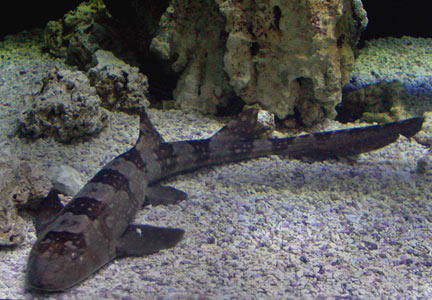
      The most hands-on and fun experience of the aquarium (for our group) was the Touch-A-Shark area.  We were allowed to touch sharks!  Not the huge and dangerous ones, of course!  The shallow pool was instead filled with White Spotted Bamboo Sharks.  An instructor told us to use two fingers to gently touch the back of the sharks.  She also told us that we shouldn't touch their head or tail as they might get annoyed, disturbed, or frightened.  Unfortunately, some of the younger kids ignored the warning and did so anyway!  One shark actually started swimming extremely quickly along the edge of the pool, moving up and down, near our hands.  It was very interesting to see what happened to the sharks when they were disturbed or frightened.  Anyway, I was eager to touch the sharks but somewhat nervous about it.  It took me about 20-some tries to finally be able to touch the back of the sharks!  Those 20-some tries consisted of me putting my hand in the water, waiting for a shark, moving my hand to touch it, chickening out 4 centimeters from the shark, quickly pulling my hand out of the water, and doing it all over again.  Also, a random guy started laughing at me.  Finally, though, when I was able to touch a shark, I was so excited and elated about it that I kept at it for at least ten more minutes!  Sadly, our group wasn't able to visit the Jules Verne Gallery, but we heard about it from others.
      All in all, this field trip to the Adventure Aquarium proved to be an extremely enlightening trip.  We were all able to learn about different sea creatures and observe them in their habitats.  Not to mention the interactive sites and the penguin exhibit!  I'd definitely love to go on another field trip like this any day.  
      
      I used this site to learn more about rainforest's.  My first picture can be found here.  My second picture is from here.  My third picture is from here.  


~Starflower794

Sunday, April 18, 2010

The Collapsing Can!

      The collapsing can.  Doesn't sound so interesting at first...But, when I observed this experiment, I easily saw how interesting and COOL it was!
      In order to do the experiment, we needed an empty aluminum soft-drink can (coke in our class), a 2- or 3-quart saucepan, a hot plate (for us), and a pair of kitchen tongs.  With only these four items, we were able to observe Charle's and Boyle's laws!  Here's how it went:
      We began by filling a large bowl with cold water and putting 15 milliliters of water into the coke can.  We then proceeded to heat the coke can on the hot plate that was provided.  At first, the coke can filled with water exuded steam, which told us that it was extremely hot and that the water inside was evaporating and condensing.  The water became steam and some stuck to the sides of the coke can as water droplets near the top.  The water in the bowl was ice cold.  When the water in the coke can was hot enough, we took the tongs and inverted the coke can into the water in the bowl.  The reaction was amazing! The coke can immediately was crushed and collapsed!
      This process applied both Charle's Law and Boyle's Law.  Charle's law states that the volume of a gas increases as the temperature increases.  Boyle's Law states that the volume of a gas decreases when the pressure increases.  These two extremely important laws were shown when the temperature around the can decreased as it was plunged into the chilling water (a decreased temperature) and likewise, its volume decreased.  They were also shown by the air pressure increasing as the liquid inside the can found its way out into the open water in the bowl and causing the volume to decrease since the air pressure was strong enough to crush it after the water was gone.  
      As you can see, this experiment proved to be much more than we all might have thought it was.  It allowed us to learn all about the powers of air pressure and how it affects everything around it.  In addition, I know now more about the two laws stated above.  Overall, this lab was a great way to learn about air pressure!


My first picture was from here.  

~Starflower794!